
DNA-based cell typing in menstrual effluent identifies cell type variation by sample collection method: toward noninvasive biomarker development for women’s health
Vlasac IM, Stolrow HG, Thayer ZM, et al.Epigenetics · 2025DOI 10.1080/15592294.2025.2453275
In plain language
Twelve healthy women collected menstrual effluent at home on day 2 of their period in three ways, with a menstrual cup, a pad liner and a vaginal swab, and DNA methylation was used to estimate which cell types each sample contained. Collection method shaped the result: cup samples held the most immune cells, swabs the most epithelial cells, and pads captured immune, epithelial and stromal cells.
Key numbers
- 12
- Healthy participants
- 36
- Samples: cup, pad and swab from each woman
- 3
- Collection methods compared
What it means
How menstrual effluent is collected changes what it contains, so studies need to choose and report their method with care. Pads, the only option that needs no insertion, still captured all three main cell groups, which matters for at-home and adolescent research.
What it does not show
A small feasibility study in healthy women with no disease comparison, and cell proportions were estimated computationally rather than counted directly. It did not test any diagnostic question.
Figures
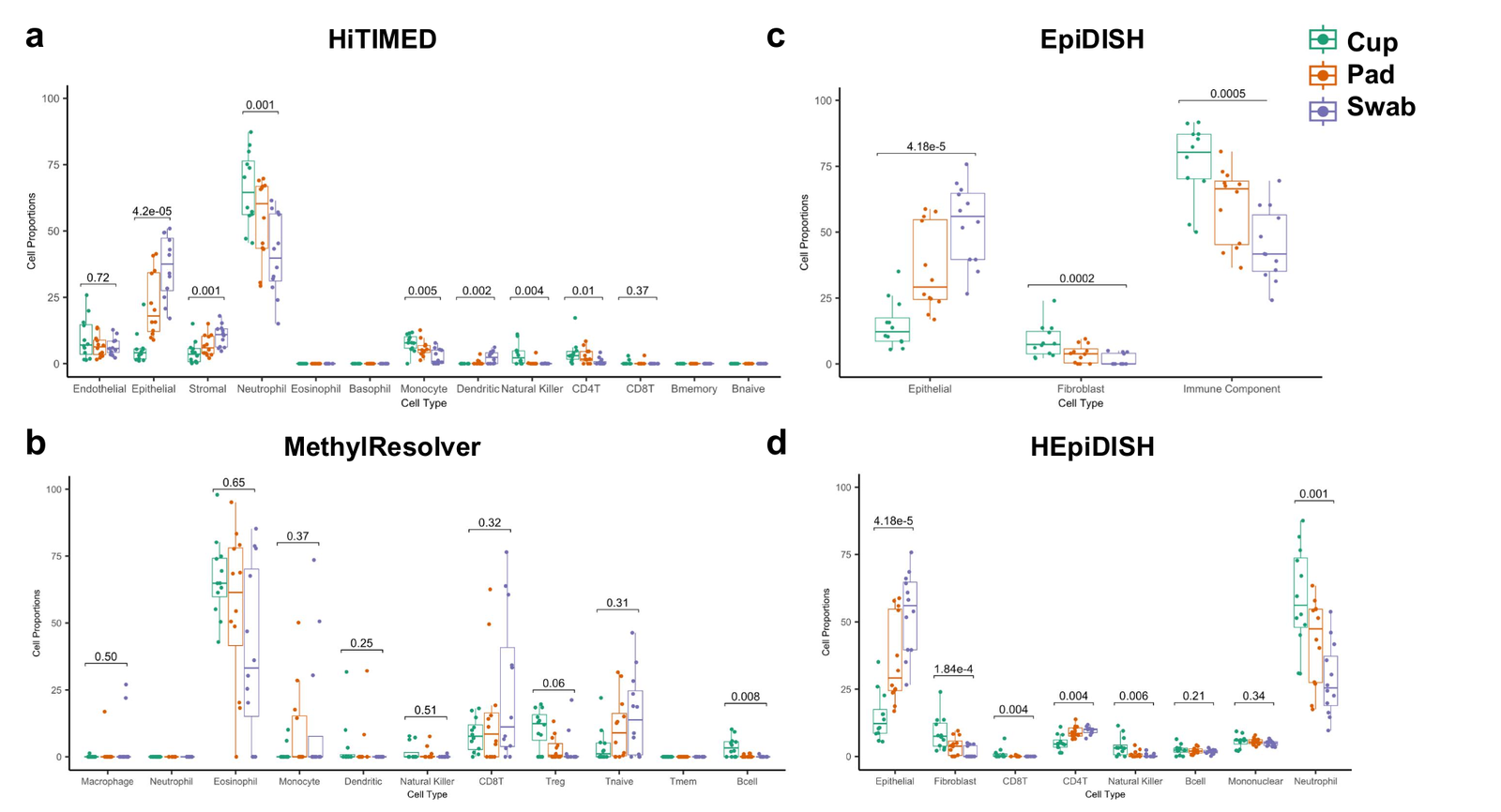
Figures reproduced unchanged from Vlasac IM et al., Epigenetics, 2025, under CC BY 4.0. Captions written by Qvin.
How to cite
Vlasac IM, Stolrow HG, Thayer ZM, Christensen BC, Rivera L. DNA-based cell typing in menstrual effluent identifies cell type variation by sample collection method: toward noninvasive biomarker development for women’s health. Epigenetics. 2025;20(1):2453275. doi:10.1080/15592294.2025.2453275