
Inflammatory Mechanisms of Dysmenorrhea: Novel Insights From Menstrual Effluent in an Adolescent Cohort
Kyathanahalli CN, Tu FF, Hellman KMBJOG: An International Journal of Obstetrics & Gynaecology · 2025DOI 10.1111/1471-0528.18275
In plain language
Menstrual effluent from the first night of a period, collected on a pad or tampon, was analyzed in 33 adolescents with period pain and 18 pain-free peers, all within three years of their first period. Those with pain had higher prostaglandin F2α (median 4.5 versus 1.1 ng/mL), but prostaglandin levels correlated only modestly with pain, and mass spectrometry in a small subset pointed to other inflammatory lipids as well.
Key numbers
- 33 vs 18
- Adolescents with period pain versus pain-free controls
- 4.5 vs 1.1 ng/mL
- Median PGF2α in menstrual effluent
- r = 0.37
- Correlation of PGF2α with pain intensity
What it means
A used pad or tampon can be analyzed for inflammatory molecules, giving a direct look at what happens in the uterus during painful periods. The modest link with pain suggests prostaglandins are only part of the story.
What it does not show
A small study in which pain on the collection night was relatively low, and the broader lipid profiling covered just 5 versus 5 participants. It explores mechanisms; it is not a test for period pain or its causes.
Figures
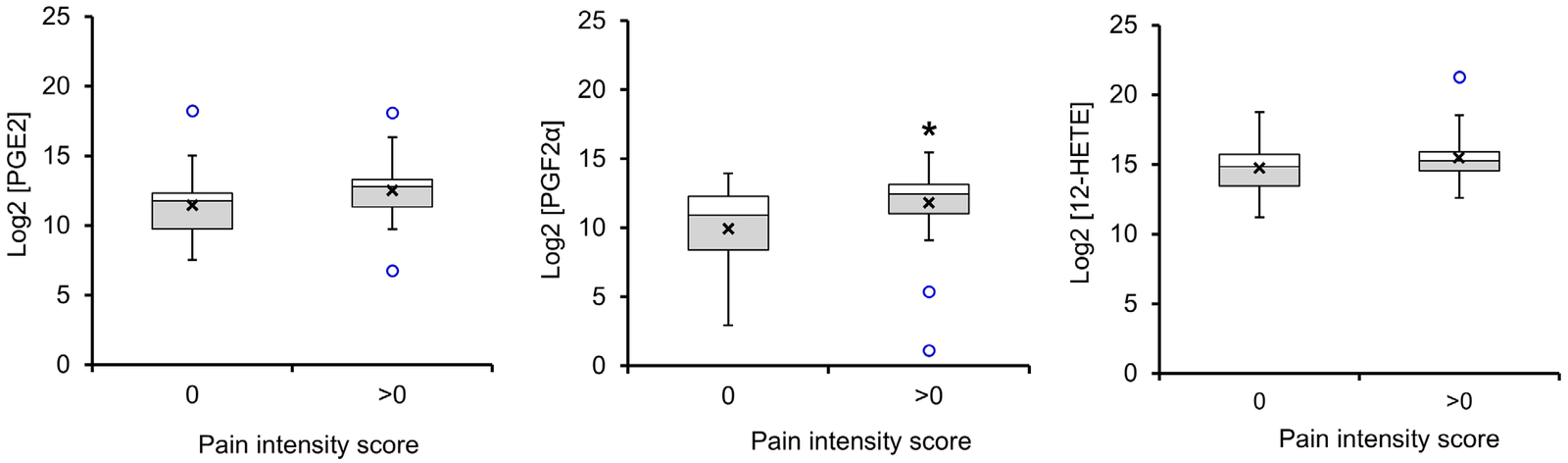
Figures reproduced unchanged from Kyathanahalli CN et al., BJOG: An International Journal of Obstetrics & Gynaecology, 2025, under CC BY 4.0. Captions written by Qvin.
How to cite
Kyathanahalli CN, Tu FF, Hellman KM. Inflammatory Mechanisms of Dysmenorrhea: Novel Insights From Menstrual Effluent in an Adolescent Cohort. BJOG: An International Journal of Obstetrics & Gynaecology. 2025;132(11):1626-1634. doi:10.1111/1471-0528.18275