
Help with your Q-Pad Kit.
Answers about the Q-Pad, collecting and returning your sample, and your account.
About the Q-Pad
What is the Q-Pad?
The Q-Pad is a menstrual pad with a removable Q-Strip. While you wear it, the Q-Strip collects a small menstrual blood sample. The sample dries in its container and travels to a laboratory by ordinary mail. No needles, no clinic visit.
The Q-Pad looks, feels and is worn like a normal menstrual pad. Your period becomes a laboratory sample, collected at home.
The Q-Pad Kit is FDA cleared as part of the Q-Pad Test System (510(k) K231465) and is CE and UKCA marked.
How does the Q-Pad work?
Your Q-Pad Kit has two Q-Pads, each with a removable Q-Strip inside. On a heavy flow day, wear Q-Pad 1 like a normal pad until the green oval is filled, for 8 hours at most. Pull the tab to remove the Q-Strip and place it in the Q-Strip Container right away. Then use Q-Pad 2 the same way.
Put the Q-Strip Container in the Return Pouch and mail it to the laboratory. The sample dries in the container on the way, so it needs no refrigeration.
Who can use the Q-Pad?
The Q-Pad Kit is for people aged 18 and over who menstruate and can wear an external menstrual pad.
Who can use a specific test depends on that test. In the United States, the Q-Pad A1c Test is FDA cleared for monitoring long-term blood sugar control in women with diabetes. In research studies, each study decides who can take part.
What is the Q-Pad made of?
The top layer that touches your skin and all the absorbent material are 100% organic cotton. The Q-Pad is unscented and has a plastic backing film. The Q-Strip is made of PET plastic film, a medical-grade adhesive and cotton-fiber collection paper of the kind used for dried blood spot testing.
The Q-Pad passed biocompatibility testing to ISO 10993, including cytotoxicity, irritation and sensitization. It contains no natural rubber latex and no PFAS.
The Q-Pad Kit:
- is FDA cleared (510(k) K231465) and CE and UKCA marked
- is manufactured under an ISO 13485-compliant quality system
- complies with California Proposition 65
- complies with the EU REACH regulation on chemicals
See the safety testing in detail on the Q-Pad Collection page.
What does the Q-Pad test for?
The Q-Pad Kit collects the sample. What the laboratory measures depends on the test or study your kit is for.
- A1c (United States): the Q-Pad A1c Test is FDA cleared for monitoring long-term blood sugar control in women with diabetes. It is not for diagnosing or screening for diabetes, and it does not replace daily blood sugar checks. The A1c test is not available to order right now.
- Research: Q-Pad samples are used in research studies, for example on HPV and hormones. Research is not a diagnosis, and you may not receive an individual result.
If you are taking part in a study, your study team can tell you what your sample is analyzed for.
I use other types of menstrual products. Is the Q-Pad still for me?
Yes. You only wear the Q-Pads for a short part of your period, on a heavy flow day. Use your usual period products before and after.
Each kit has two Q-Pads. How long each one takes to fill depends on your flow. Never wear a Q-Pad for more than 8 hours.
Why is there a green oval on the Q-Pad?
The green oval shows where your sample collects. When the oval is filled, you have collected enough: remove the Q-Strip and switch to Q-Pad 2.
The ink is safe. It was tested on its own for biocompatibility and is not toxic to cells.
Does the Q-Pad expire?
Yes. The Q-Pad Kit has a shelf life of three years from manufacture. The expiration date is printed on the kit packaging.
Store the kit at room temperature, 15 to 30 °C (59 to 86 °F). Keep each Q-Pad in its sealed pouch until you use it. Once you open a kit, use it within 60 days.
Using your Q-Pad Kit
Registering your kit
How do I register my Q-Pad Kit?
Register your kit in the Qvin app before you use it:
- Open the Qvin app and tap “Register your kit” on the Health tab.
- Scan the QR code on the Q-Pad 1 pouch, or type in the Q-Pad ID.
You only register Q-Pad 1. Q-Pad 2 is linked to your account automatically.
No smartphone? Fill in the Identification Form in your Return Pouch and send it back with your Q-Strips.
When do I register my Q-Pad Kit?
Register your kit any time before you use it: as soon as it arrives, or when your period starts. Registering early means you get reminders from the app.
Why do I need to register my Q-Pad Kit?
Registering links your kit to your Qvin account, so the laboratory can match your sample to you and you can follow it in the app. Register before you use the Q-Pads.
If you cannot use the app, fill in the Identification Form in your Return Pouch instead.
Can I unlink my Q-Pad Kit from my account?
If you no longer plan to use your Q-Pads, you can unlink the kit from your account:
- Open your kit on the Health tab of the Qvin app.
- Open the kit menu and tap “Unlink this Kit”.
- Confirm with “Unlink”.
You can link the kit again later, as long as it has not expired.
Collecting your sample
It's my first time using the Q-Pad. What should I know?
Here is how to make your collection smooth:
- Get ready. Keep your Q-Pad Kit with your period products and set a reminder for when your period is due. Register the kit in the Qvin app as soon as it arrives.
- Start in the app. When you are ready, tap “Begin collection” in the app before you put on Q-Pad 1. This starts your 72 hours to mail the kit.
- Pick a heavy flow day. Use the Q-Pads on the day your flow is heaviest. That day is different for everyone.
- Keep the area clean. Do not use creams, lubricants, moisturizers, wipes or deodorants in or on your vagina before or while you wear the Q-Pad.
- Check early. Look at the Q-Pad within the first hour to make sure blood is collecting in the green oval, and reposition it if needed. This also helps prevent leaks.
- 8 hours at most. Never wear a Q-Pad for more than 8 hours.
- Keep the Q-Strip Container with you. Put each Q-Strip in it as soon as you remove it.
- Mail it quickly. Mail your Return Pouch within 72 hours of tapping “Begin collection”.
Always send back what you collected, even if the oval is not full or your period stopped. The laboratory checks every sample, and if it cannot be used, we will contact you about next steps.
When should I use the Q-Pads?
Use the Q-Pads on a day when your flow is heavy. There is no fixed cycle day: your heaviest day may be different from someone else’s. A good guide is the day you would normally reach for your most absorbent period products.
How do I use the Q-Pads?
Wear the Q-Pad like a normal menstrual pad. Place it in your underwear with the “front” label pointing forward and fold the wings to secure it. When the green oval is filled, or after 8 hours at most, pull the tab to remove the Q-Strip and place it in the Q-Strip Container. Then wrap and throw away the pad. Do not flush it.
The printed instructions in your kit cover every step, and the Qvin app guides you through them after you register the kit.
Can I use creams, lubricants or wipes while using the Q-Pad?
No. Do not use creams, lubricants, moisturizers, wipes or deodorants in or on your vagina before or while you wear the Q-Pad. They can make your results inaccurate. Make sure your intimate area is clean before you put on the Q-Pad.
Is my flow heavy enough?
Flow peaks at different times for different people. Use your Q-Pads on the day your flow is heaviest.
Try to fill the green oval completely. How long that takes depends on your flow: for some people it takes 30 minutes, for others several hours. Never wear a Q-Pad for more than 8 hours. If it is your first time, check the Q-Pad every hour.
How do I position my Q-Pad correctly?
The green oval shows where blood should collect. It can take one or two adjustments to get the position right, so check the Q-Pad within the first hour and reposition it if needed.
When the oval is filled, remove the Q-Strip and place it in the Q-Strip Container.
Having trouble filling the oval? Send back what you collected anyway. The laboratory may still be able to use it. Questions? Email hello@qvin.com.
Is sample anxiety normal?
Yes. It is normal to feel unsure the first time, about where to place the pad or whether you collected enough. That is why every kit has two Q-Pads: if one does not go to plan, you can use the other.
Always send back your Q-Strips. The laboratory checks every sample. If yours cannot be used, we will let you know and help with next steps.
Can I wear a thong?
We do not recommend a thong. Full-coverage underwear holds the Q-Pad in place, helps blood collect in the oval and helps prevent leaks.
You only need the Q-Pads for a short part of your period, so you can wear your usual underwear before and after.
Can I use a menstrual cup and pour it on the Q-Strip?
No. Do not pour menstrual fluid onto the Q-Strip. The sample has to soak into the Q-Strip while you wear the Q-Pad, because the weight and pressure of wearing it are part of collection. You only wear the Q-Pads for a short time, so you can use your cup before and after.
Do I need to use my Q-Pads right away?
No. Use your Q-Pads in any period that suits you, unless your study team asked you to use them at a certain time. Keep in mind:
- Use the kit before the expiration date printed on the packaging, and within 60 days of opening it.
- Keep each Q-Pad in its sealed pouch until you use it.
- If you use Q-Pad 2, use it in the same period as Q-Pad 1. A kit cannot be split across two periods.
I lost a Q-Strip or a Q-Pad
If you still have one used Q-Strip, send it back. The laboratory may be able to use it. Mail it within 72 hours of tapping “Begin collection” in the app.
If you lost both Q-Strips or both Q-Pads, contact your study team for a new kit. If you are not in a study, email hello@qvin.com.
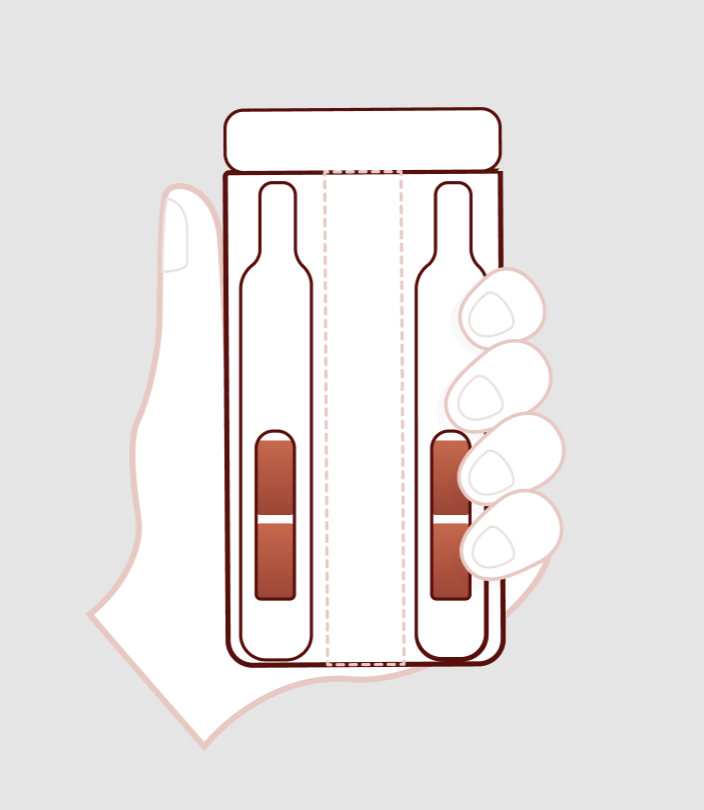
How do I put the Q-Strips in the Q-Strip Container?
The Q-Strip Container holds one Q-Strip on each side. The Q-Strips slide in, but the fit can be snug. If a Q-Strip will not go in, hold the container by its thin sides and press lightly to open it a little, as shown below.
I’m done with my Q-Pad but don’t have the Q-Strip Container with me
Put each Q-Strip in the Q-Strip Container as soon as you remove it. If the container is not with you, keep wearing the Q-Pad, for 8 hours at most, until you can.
If you already removed a Q-Strip and could not put it in the container, it cannot be used. Throw it away and send back the other Q-Strip on its own. The laboratory may still be able to use it.
If neither Q-Strip made it into the container, contact your study team for a new kit, or email hello@qvin.com if you are not in a study.
When do I start using Q-Pad 2?
Put on Q-Pad 2 as soon as you finish Q-Pad 1, while your flow is still heavy. Use both Q-Pads in the same period.
My period stopped before I could fill the oval
Place the Q-Strip or Q-Strips you used in the Q-Strip Container and send them back. The laboratory may still be able to analyze a small sample, even from one Q-Strip.
If you only used Q-Pad 1, you can throw away Q-Pad 2. A kit cannot be split across two periods, so send back what you have.
How do I prevent leaks?
- Wear full-coverage underwear that holds the Q-Pad in place.
- Fold the wings around your underwear to secure the pad.
- Avoid activities that make the Q-Pad move around.
- Check the Q-Pad often, and remove the Q-Strip as soon as the oval is filled.
- Adjust the Q-Pad if a leak looks likely.
- If the Q-Pad is small for your flow, wear a second pad underneath it.
- Turn on notifications in the Qvin app to get reminders.
My Q-Pad leaked. What should I do?
Pull the tab to remove the Q-Strip and place it in the Q-Strip Container, even if the oval is not filled. Then start Q-Pad 2 if you have not used it yet. Try a slightly different position and check it more often.
If the Q-Pad is small for your flow, wear a second pad underneath it. Leaks happen, so always send back what you collected.
My flow is too light to fill the oval.
Some people fill the oval in 30 minutes, others take a few hours. Wear the Q-Pad longer if you can, but never more than 8 hours.
If you still cannot fill the oval, place the Q-Strip in the Q-Strip Container. If you are on Q-Pad 1, continue with Q-Pad 2 and collect what you can.
Send back what you collected, even if the ovals are not full. The laboratory may still be able to analyze it, and we will contact you if there is a problem.
Can I use my Q-Pad Kit across two periods?
No. Use a Q-Pad Kit in a single period, unless your study team told you otherwise. If something goes wrong with your kit, send it back anyway: we will contact you if there is a problem with your sample. If you need another kit, contact your study team, or email hello@qvin.com if you are not in a study.
Urine got on my Q-Pad. What should I do?
If you urinated on the Q-Pad, or a lot of urine got onto it, email hello@qvin.com before you send your sample back. We will tell you what to do.
Shipping your sample
How do I prepare my sample for shipping?
- Make sure your Q-Strips are in the Q-Strip Container and it is closed.
- Put the Q-Strip Container back in the Return Pouch.
- Peel off the liner and seal the Return Pouch.
The Return Pouch is prepaid and addressed to the laboratory. Next, mail it: see “How do I ship my sample?”.
How do I ship my sample?
Your Return Pouch is prepaid and addressed to the laboratory, so there is no postage to pay. Mail it within 72 hours of tapping “Begin collection” in the app.
- United States: drop it in a USPS mailbox or at a post office, or leave it in your home mailbox for pickup. On weekends, use a blue USPS collection box or the post office so it is picked up on time.
- United Kingdom: post it in a Royal Mail postbox.
- If your study team asked you to hand it in, give the sealed Return Pouch to them.
Then tap “I’ve mailed my kit” in the Qvin app.
When do I ship my sample?
Mail your Return Pouch as soon as you finish with the Q-Pads, and within 72 hours of tapping “Begin collection” in the app. The app shows how much time you have left. The sooner it reaches the laboratory, the less chance of carrier delays.
Missed the 72 hours? Mail it right away anyway. The laboratory may still be able to analyze it, and we will let you know if it cannot be tested. Questions? Email hello@qvin.com.
How do I track the status of my sample?
Open the Health tab in the Qvin app. Your kit’s status updates when the carrier picks up your Return Pouch and when it arrives at the laboratory.
Where are my samples run?
Your sample goes to the laboratory named on your Return Pouch. Each kit is addressed to the laboratory that runs the test or study it is for.
Your results
Will I get my results?
It depends on what your kit is for.
- Clinical tests: your result appears in the Qvin app after the laboratory has reviewed and released it. We notify you when it is ready.
- Research studies: many studies do not return individual results. Your consent form explains what you will receive, and your study team can answer questions.
A result does not replace medical advice. Talk to your healthcare provider before you change any medication or treatment.
Your account
How do I create an account?
- Download the Qvin app from the App Store or Google Play.
- Open the app and tap “Create account”.
- Sign up with your email (we send you a sign-in link), with Apple or with Google.
- Add your name, date of birth, country and phone number, and accept the terms.
Having trouble? Email hello@qvin.com.
How do I sign in?
The Qvin app does not use passwords. Open the app and choose "Continue with email", enter the email address you signed up with, and we send you a sign-in link. Open the link on the phone that has the Qvin app installed to sign in.
If you created your account with Apple or Google, choose "Continue with Apple" or "Continue with Google" instead.
If you are having trouble signing in, please reach out to hello@qvin.com.
How do I delete my account?
You can delete your account in the Qvin app:
- Sign in to the Qvin app. If you cannot sign in, choose “Continue with email” to get a new sign-in link.
- Tap the profile icon at the top of the screen to open your account menu.
- Tap “Profile details”.
- Scroll to the bottom and tap “Delete Account”.
- Confirm, then complete the final verification step.
Deleting your account permanently removes your data from our system. It cannot be recovered afterwards.
Read how we handle your data in our privacy policy, or email hello@qvin.com with any questions.
The science
Testing menstrual blood
How has the Q-Pad been studied and validated?
Every Qvin test is validated on its own before it is used, for accuracy, precision, stability and more. Results for one marker do not carry over automatically to another.
The Q-Pad A1c Test went through FDA review and was cleared in December 2023 (510(k) K231465). In a home-collection study of 198 participants, A1c from the Q-Pad matched A1c from a venous blood draw (R² = 0.99).
We also publish our research in peer-reviewed journals. See all our publications at qvin.com/science/publications.
What’s in menstrual blood and how are you able to test it?
Menstrual blood is a mix of:
- blood from your circulation
- shed tissue and cells from the lining of the uterus (the endometrium)
- fluid and cells from the cervix and vagina
Because it contains whole blood, some markers in menstrual blood track closely with a venous blood draw. In Qvin’s published studies, A1c and the hormones TSH, AMH, FSH and LH measured on the Q-Pad correlated strongly with venous blood. Not every marker does: glucose did not match in our first pilot study. That is why every marker is validated on its own.
Because it passes through the cervix and vagina, menstrual blood can also carry signals such as HPV. In a Qvin study, when the two were collected within two months of each other, menstrual blood found high-risk HPV in 43 of 46 people whose clinician-collected cervical sample was positive.
Researchers are also studying menstrual blood in areas such as endometriosis. This work is at an early research stage and is not a test today.
Is processing my menstrual blood sample different from processing a venous blood sample?
Your Q-Strip holds a dried sample, similar to the dried blood spots used in newborn screening. At the laboratory, a small piece of the Q-Strip is punched out and the sample is dissolved back into liquid. From there it is analyzed on standard laboratory analyzers and reagents, the same kind used for blood drawn from a vein.
Dried samples need only a little blood, travel by ordinary mail without refrigeration, and are collected without a needle.
Why hasn’t menstrual blood been tested in the past?
Menstrual blood was long seen as waste, and in many cultures it is still taboo. Dr. Sara Naseri, Qvin’s co-founder and CEO, began researching it in medical school as a simple way to gain health insights without a needle. It took time to convince other doctors and scientists, but the work led to our first publication in 2019, which showed that several markers in menstrual blood correlate with venous blood.
Our publications
Concordance of hemoglobin A1c and reproductive hormone levels in menstrual and venous blood
Read the publication (F&S Reports, 2024)
What we did
152 people aged 19 to 50 with regular periods collected menstrual blood on the Q-Pad and had venous blood drawn within 60 hours.
What we found
Q-Pad results correlated strongly with venous blood for A1c (r = 0.96) and for the hormones TSH, AMH, FSH and LH (r = 0.91 to 0.94). In samples from three participants, A1c stayed stable on the dried Q-Strip for 53 days and the hormones for 15 days. The hormone results are published research, not cleared tests.
Novel use of menstrual blood for monitoring glycaemic control in patients with diabetes: a proof-of-concept study
Read the publication (BMJ Sexual & Reproductive Health, 2022)
Why we did this study
A1c shows average blood sugar over the past few months. People with diabetes are advised to check it regularly, which usually means a blood draw. We asked whether A1c from menstrual blood collected on the Q-Pad matches A1c from a venous blood draw.
What we did
172 people of reproductive age, 73 of them with type 1 or type 2 diabetes, collected menstrual blood on the Q-Pad and had venous blood drawn during their period.
What we found
Average A1c was 6.53% in menstrual blood and 6.50% in venous blood, with a strong correlation (r = 0.949). This work helped lay the foundation for the FDA-cleared Q-Pad A1c Test, for monitoring long-term blood sugar control in women with diabetes.
Screening for High-Risk Human Papillomavirus Using Passive, Self-Collected Menstrual Blood
Read the publication (Obstetrics & Gynecology, 2022)
Why we did this study
High-risk HPV causes virtually all cervical cancers, and regular screening finds it early. Screening usually means a clinic visit and a cervical sample. We asked whether high-risk HPV can be detected in menstrual blood collected passively on a pad.
What we did
153 people who came for cervical screening, or had tested positive for high-risk HPV before, gave a clinician-collected cervical sample and wore a modified menstrual pad, an early version of the Q-Pad, during their next period. 106 provided both samples.
What we found
When the two samples were collected within two months of each other, the pad found high-risk HPV in 43 of 46 people whose clinician sample was positive. It was also positive in 12 people whose clinician sample was negative. Most participants who answered preferred the pad to clinician collection.
Qvin’s HPV work continues in the EQUIP clinical study. The Q-Pad is not a cleared HPV test today.
Comparative Assessment of Serum versus Menstrual Blood for Diagnostic Purposes: A Pilot Study
Read the publication (Journal of Clinical and Laboratory Medicine, 2019)
Why we did this study
This was Qvin’s first published study. Before building the Q-Pad, we asked a basic question: can menstrual blood be used for blood testing?
What we did
Participants collected menstrual blood with a menstrual cup. Menstrual and venous blood were dried on blood spot cards and tested for nine markers by a laboratory that did not know which sample was which. 20 participants had enough sample to analyze.
What we found
Eight of the nine markers correlated between menstrual and venous blood: cholesterol, creatinine, FSH, A1c, HDL, hsCRP, LDL and triglycerides. Glucose did not. The study was small, but it showed that menstrual blood is a promising sample, and why every marker must be validated on its own.
About Qvin
What does Qvin mean and how do you pronounce it?
Qvin is pronounced “kwin”. The name is a nod to “kvinde”, the Danish word for woman, and to our founders’ Danish heritage. We stand for everyone who menstruates.
How do I take part in research studies?
Open the Research tab in the Qvin app to see the studies enrolling in your country. You can join a study directly from there, or browse current studies at research.qvin.com.
New studies are added regularly, so check back.
How do I get in touch?
For all questions about using the Q-Pads or the Qvin app, please reach out to us at hello@qvin.com.
If you are taking part in a research study, your study team is your first point of contact for questions about the study and for replacement kits.
No answers match your search. Email us at hello@qvin.com and we will help.