

Building the world’s largest repository of menstrual samples.
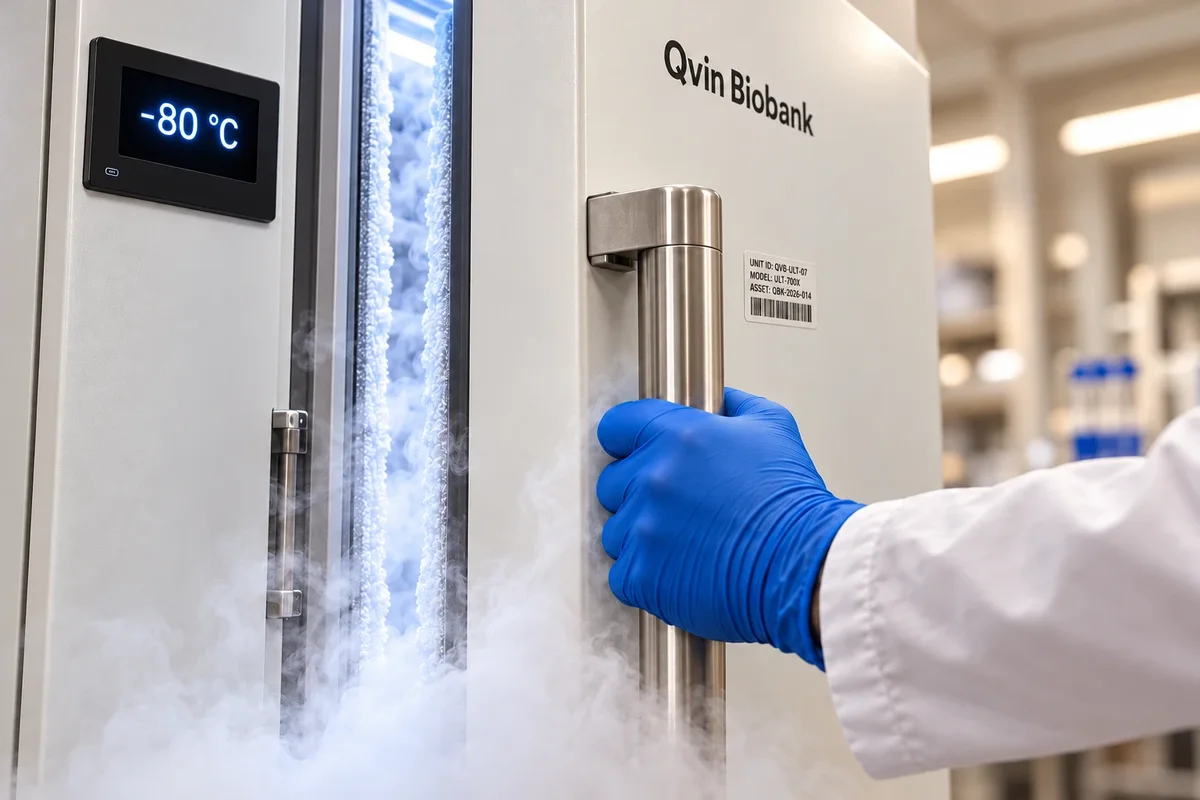
Across our laboratory network, every consented sample is stored at −80 °C, with full traceability from the kit it came in to every test it has seen.

- −80 °CUltra-low freezers, with backup power
- Row, rack, binThe exact place of every sample
- ConsentedOnly samples with biobank consent are stored
- One recordFrom the kit to every test, for every sample
Every sample, biobanked in Samples.
Lab staff biobank in Samples, the same app they use for intake and prep. Consented kits go into a pouch, the pouch goes into the freezer at a recorded place, and the labels print. Anyone can find any sample again.
Animation of the Pouches page in the Samples App: pouch QVBAAD with three consented kits is added to the -80 °C freezer at row 1, rack 2, bin 3, and its label prints.
Consent first
Only kits with biobank consent can be stored. If consent is withdrawn, the kit is flagged to be removed and disposed of.
An exact place
Every pouch is stored in a named freezer, at a recorded row, rack and bin.
Labels that match
The pouch label and each kit’s sleeve label print from the same app, with every ID on them.
In and out, on record
Every time a pouch or a kit leaves the freezer, it is recorded, with who and when.
One record that follows the sample everywhere.
- OriginThe kit and its manufacturing lot.
- CollectionWhen the sample was collected, shipped and received.
- Chain of custodyEvery scan, label and handler, with a time stamp.
- PreparationsEach extraction tube and aliquot, with its own ID.
- TestsEvery assay run on the sample, and its result status.
- StorageThe pouch, the freezer and the exact place it is kept.
- Kit lot
- K20260903A
- Received
- Accessioned, 7 of 7 criteria met
- Q-Strips
- Q-Pad 1 used · Q-Pad 2 stored
- Tested for
- Hormones
- Consent
- Biobank consent on record
- Location
- −80 °C · Row 1 · Rack 2 · Bin 3
Today’s samples, tomorrow’s discoveries.
A stored sample keeps its value. Linked to a person’s later health, and shared under consent, samples collected today can help researchers find signals that no single study could.
- 01
Look back in time
When a condition is diagnosed, researchers can return to samples the same person gave months or years before, and look for the first signs.
- 02
New methods on stored samples
As new tests are developed, they can run on samples already in the freezer. DNA methylation has been read from Q-Strips stored for over two years.
- 03
Collaboration across labs
Every sample in the network is collected, handled and recorded the same way, so research groups can combine their samples and compare their results.
- 04
Within each person’s consent
Samples are only used for research the participant agreed to, and personal data is kept apart from sample and health data.
Where it could matter. Conditions that are hard to catch early, and that menstrual blood may carry signals of. Some are near, others a longer shot, all worth studying.
- Endometriosis
- Adenomyosis and fibroids
- Endometrial cancer
- Early signs of ovarian cancer
- Fertility and pregnancy loss
- Perimenopause
Build your research on samples you can trace.
Work with the Qvin biobank, or bring our way of biobanking to your own lab.