
Menstrual Blood as a Non-Invasive Alternative for Monitoring Vitamin Levels
Whitbread AL, Mittelmeier L, Rao RP, et al.Journal of Clinical Medicine · 2024DOI 10.3390/jcm13237212
In plain language
In 30 healthy women, menstrual blood collected with a menstrual cup on day 2 of the period and a finger-prick capillary sample were both spotted onto dried blood spot cards and measured by mass spectrometry. Vitamin A and vitamin D in menstrual blood correlated with capillary blood (r = 0.77 and 0.66) but were consistently lower, and hemoglobin did not correlate.
Key numbers
- 30
- Healthy women with paired samples
- r = 0.77
- Vitamin A, menstrual versus capillary blood
- r = 0.66
- Vitamin D, menstrual versus capillary blood
What it means
Vitamins A and D can be measured in dried menstrual blood and track finger-prick levels, a first step toward a menstrual vitamin test. Because the values were lower and not interchangeable, menstrual-specific reference ranges would be needed.
What it does not show
A small pilot compared against capillary, not venous, blood, with no clinical validation. Vitamin K2 and methylmalonic acid were too low to measure in many samples.
Figures
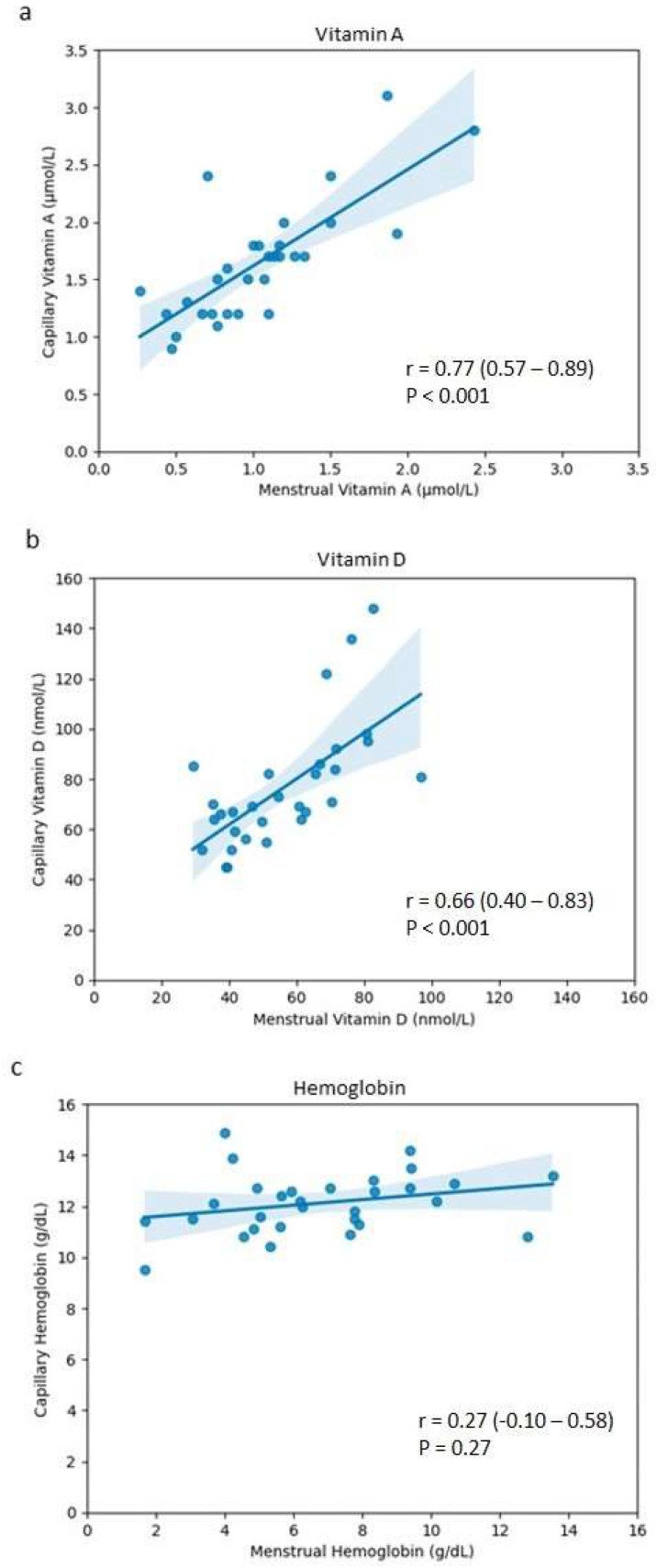
Figures reproduced unchanged from Whitbread AL et al., Journal of Clinical Medicine, 2024, under CC BY 4.0. Captions written by Qvin.
How to cite
Whitbread AL, Mittelmeier L, Rao RP, Mittelmeier W, Osmanski-Zenk K. Menstrual Blood as a Non-Invasive Alternative for Monitoring Vitamin Levels. Journal of Clinical Medicine. 2024;13(23):7212. doi:10.3390/jcm13237212